
The “Promote” (“Carry” or Carried Interest) and the “Catch-Up” are the engine room of private equity economics. They define how profits are split between the investors (LPs) who put up the money and the sponsor (GP) who does the work.
While everyone knows the “20%” headline, the waterfall—the specific order in which cash flows—determines whether that 20% is fair or expensive.
1. The “Promote” (“Carry” or Carried Interest)
Definition: The Promote is the performance fee earned by the sponsor after investors have received their money back plus a minimum return.
-
Purpose: It aligns incentives. The sponsor only gets “rich” if the deal performs well.
-
Standard Rate: Typically 20% of profits (in PE) or 15–20% (in Real Estate/Club Deals).
-
Mechanism: It is not a salary; it is a share of the upside.
2. The “Hurdle Rate” (Preferred Return)
Definition: The minimum annual return (IRR) investors must earn before the sponsor sees a dime of performance fees.
-
Standard: Usually 8% compounding annually.
-
Function: Think of it as “interest” on your capital. Until the project pays you back your $1M investment + this 8% interest, the sponsor gets 0% promote.
3. The “Catch-Up” (The Tricky Part)
Definition: A mechanism that allows the sponsor to “catch up” on their 20% profit share once the Hurdle is met.
-
How it works: Without a catch-up, the sponsor would only get 20% of profits above the 8% return. With a 100% Catch-Up, once LPs get their 8%, the sponsor gets every dollar of profit until their total take equals 20% of the entire profit (not just the excess).
-
Why it matters: It dramatically increases the sponsor’s payout on deals that perform moderately well (e.g., a 12-15% IRR).
How the Waterfall Flows (Step-by-Step)
Imagine a “European” (Whole-of-Fund) waterfall. Cash fills the buckets in this strict order:
-
Return of Capital: 100% of cash goes to LPs until they have their initial investment back ($1M).
-
(Sponsor gets $0)
-
-
Preferred Return (Hurdle): 100% of cash goes to LPs until they hit their 8% annual return.
-
(Sponsor gets $0)
-
-
GP Catch-Up: 100% of available cash goes to the Sponsor until they have received 20% of the total profits distributed in steps 2 & 3.
-
(Sponsor catches up to their 20% share)
-
-
Carried Interest (The Split): Remaining profits are split 80% to LPs and 20% to Sponsor.
-
(The “alignment” phase)
-
Illustration: Profit Example on $100M investment
Let’s assume a project returns exactly enough profit to trigger these stages.
| Bucket | Cash Allocation | Who gets it? | Logic |
|---|---|---|---|
| 1. Capital Back | First $100M | Investors (100%) | “Risk off the table.” |
| 2. Hurdle (8%) | Next $8M | Investors (100%) | “Interest on capital.” |
| 3. Catch-Up | Next $2M | Sponsor (100%) | Sponsor gets 20% |
| 4. Super Profits | All remaining | 80% LP / 20% GP | Pari-passu profit sharing. |
The Trap: In a deal with no catch-up, the sponsor would simply take 20% of the “Super Profits” bucket and get nothing from bucket 3. The catch-up effectively transfers that $0.02M from the investor to the sponsor.
Distribution Waterfall: Allocation of Cash Flows between LP and GP
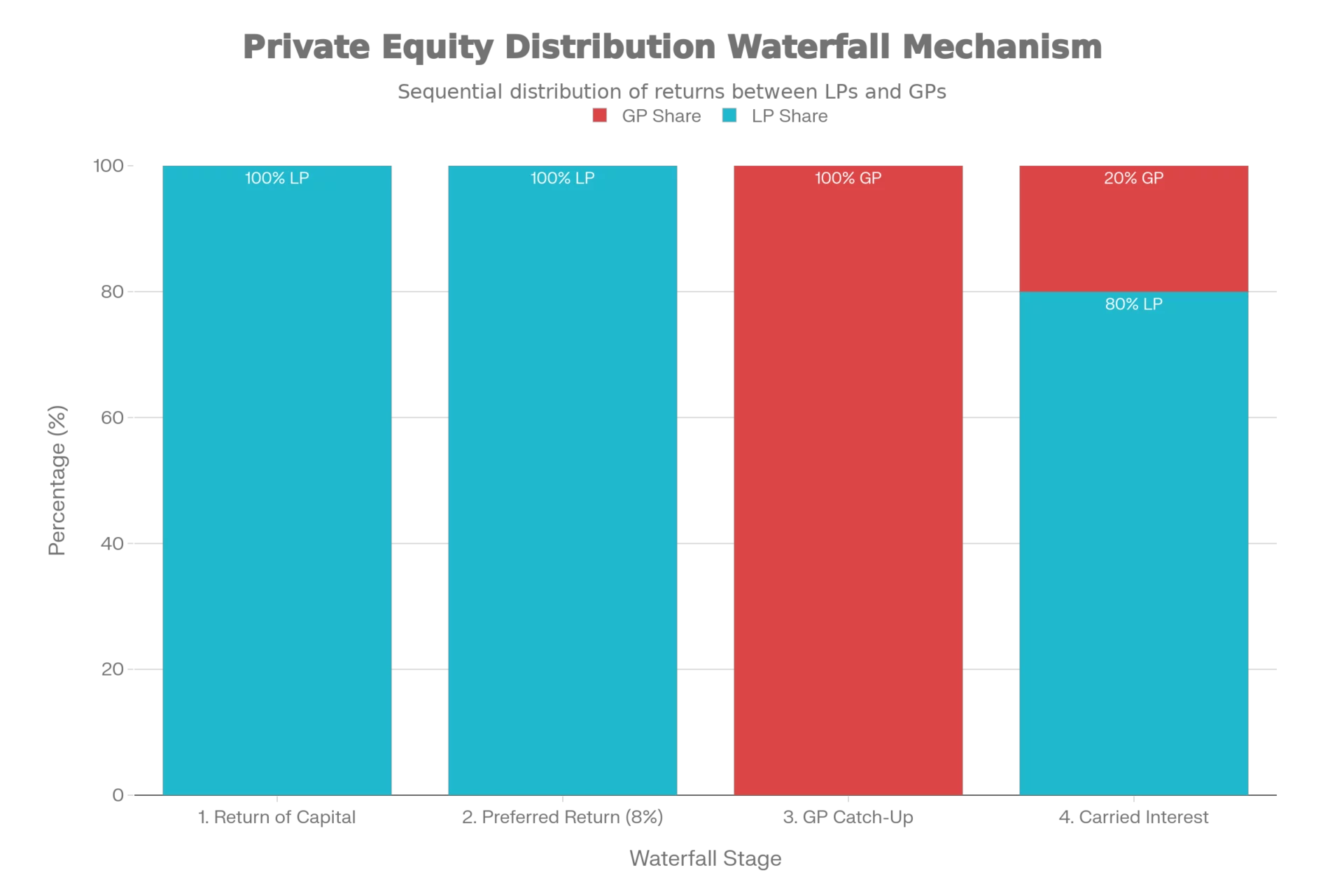
Explanations:
-
Step 1 & 2 (Blue): You see the LP receiving 100% of the cash for both Capital Return and the 8% Preferred Return. The Sponsor (GP) is still waiting.
-
Step 3 (Orange): The “Catch-Up” kicks in. Here, the bar turns completely orange because the Sponsor effectively takes 100% of the marginal cash flow at this specific moment to catch up to their profit share.
-
Step 4 (Split): Finally, the bar shows the steady-state 80/20 split for all remaining upside.
This visual confirms why the Catch-Up is the most critical negotiation point for deals with moderate returns (10-15% IRR), as it represents a zone of 100% economics for the sponsor.
